XAOC Devices Rostock
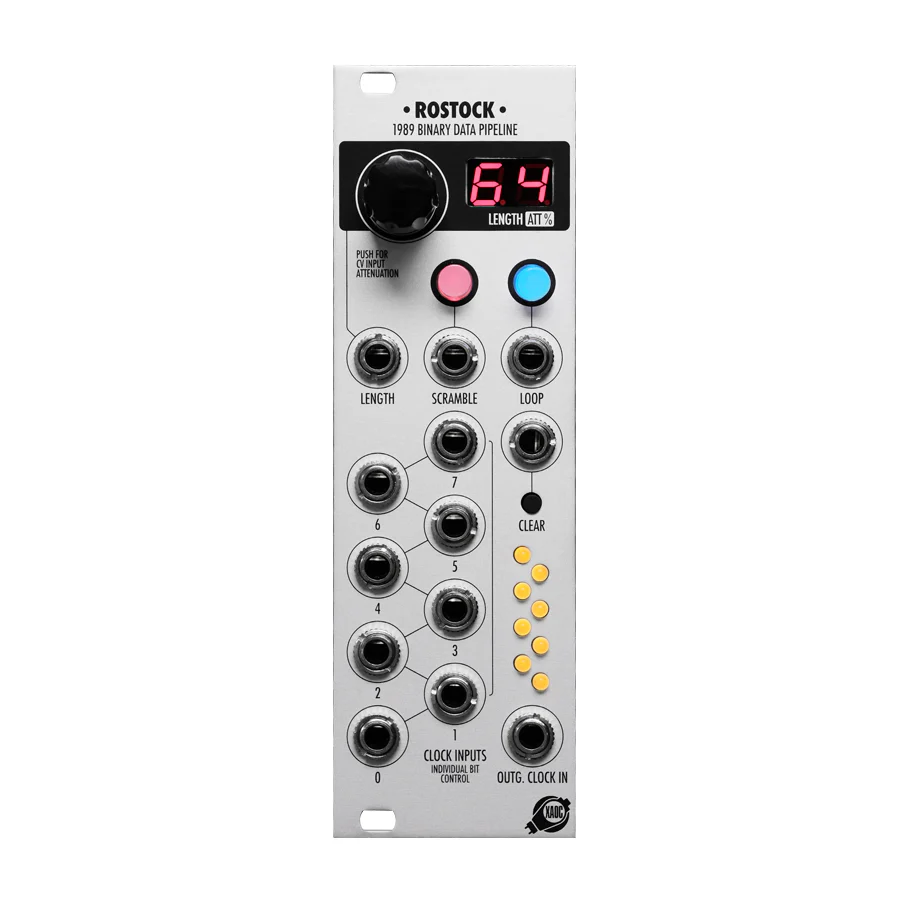
Rostock [ˈrɔstɔk] is a component of the Leibniz Binary Subsystem. It is a data pipeline, a FIFO (first in—first out) shift register, or a very short digital delay. The module operates similarly to a BBD delay or an ASR (analog shift register), except that it is digital. It consists of a chain of memory cells that pass bits from one to another at each clock cycle. The delay length is variable from 1 to 64 stages (with optional looping and scrambling). It works by processing data in the Leibniz bus and must be connected to other Leibniz modules using data ribbon cables at the back.
Rostock may process data sequences representing rhythms, control voltages, audio-rate signals, and even video signals because the bits can change at extreme rates (up to 2MHz). In addition, its memory may be digitally looped. Delaying and looping is a fundamental building block for sequence automation, pattern and chaos generation, and various cybernetic modular patches. Thus, Rostock is a multi-purpose open-ended device that invites creative thinking.
- Width: 8HP
- Power: 70mA @ +12V / 40mA @ -12V
- Depth: 40mm (including ribbon cable brackets)
Product Information
Product Information
Shipping & Returns
Shipping & Returns
XAOC Devices Rostock
XAOC Devices Rostock
Rostock [ˈrɔstɔk] is a component of the Leibniz Binary Subsystem. It is a data pipeline, a FIFO (first in—first out) shift register, or a very short digital delay. The module operates similarly to a BBD delay or an ASR (analog shift register), except that it is digital. It consists of a chain of memory cells that pass bits from one to another at each clock cycle. The delay length is variable from 1 to 64 stages (with optional looping and scrambling). It works by processing data in the Leibniz bus and must be connected to other Leibniz modules using data ribbon cables at the back.
Rostock may process data sequences representing rhythms, control voltages, audio-rate signals, and even video signals because the bits can change at extreme rates (up to 2MHz). In addition, its memory may be digitally looped. Delaying and looping is a fundamental building block for sequence automation, pattern and chaos generation, and various cybernetic modular patches. Thus, Rostock is a multi-purpose open-ended device that invites creative thinking.
- Width: 8HP
- Power: 70mA @ +12V / 40mA @ -12V
- Depth: 40mm (including ribbon cable brackets)
Product Information
Product Information
Shipping & Returns
Shipping & Returns
Description
Rostock [ˈrɔstɔk] is a component of the Leibniz Binary Subsystem. It is a data pipeline, a FIFO (first in—first out) shift register, or a very short digital delay. The module operates similarly to a BBD delay or an ASR (analog shift register), except that it is digital. It consists of a chain of memory cells that pass bits from one to another at each clock cycle. The delay length is variable from 1 to 64 stages (with optional looping and scrambling). It works by processing data in the Leibniz bus and must be connected to other Leibniz modules using data ribbon cables at the back.
Rostock may process data sequences representing rhythms, control voltages, audio-rate signals, and even video signals because the bits can change at extreme rates (up to 2MHz). In addition, its memory may be digitally looped. Delaying and looping is a fundamental building block for sequence automation, pattern and chaos generation, and various cybernetic modular patches. Thus, Rostock is a multi-purpose open-ended device that invites creative thinking.
- Width: 8HP
- Power: 70mA @ +12V / 40mA @ -12V
- Depth: 40mm (including ribbon cable brackets)


