SOMA Laboratory Lyra-8 - Pink
Welcome to the world of sound of LYRA-8, the unique organismic analogue synthesizer designed by Vlad Kreimer. “Organismic” means that LYRA uses some principles that lie in the base of living organisms. The way how LYRA’s modules interacting between each other and the behaviour of the instrument resembles a live conversation.
LYRA-8 is based on eight generators, which will be referred to as voices. Their design is not like a traditional subtractive synthesis VCO. Instead of having a linear or logarithmic dependency on control voltage, they resemble the tone generators in old electric organs. Hence the use of the term “voices” instead of “VCOs”. Lyra uses non-linearity a lot, and the voices are constructed in such a way that allows for non-linearity to express itself.
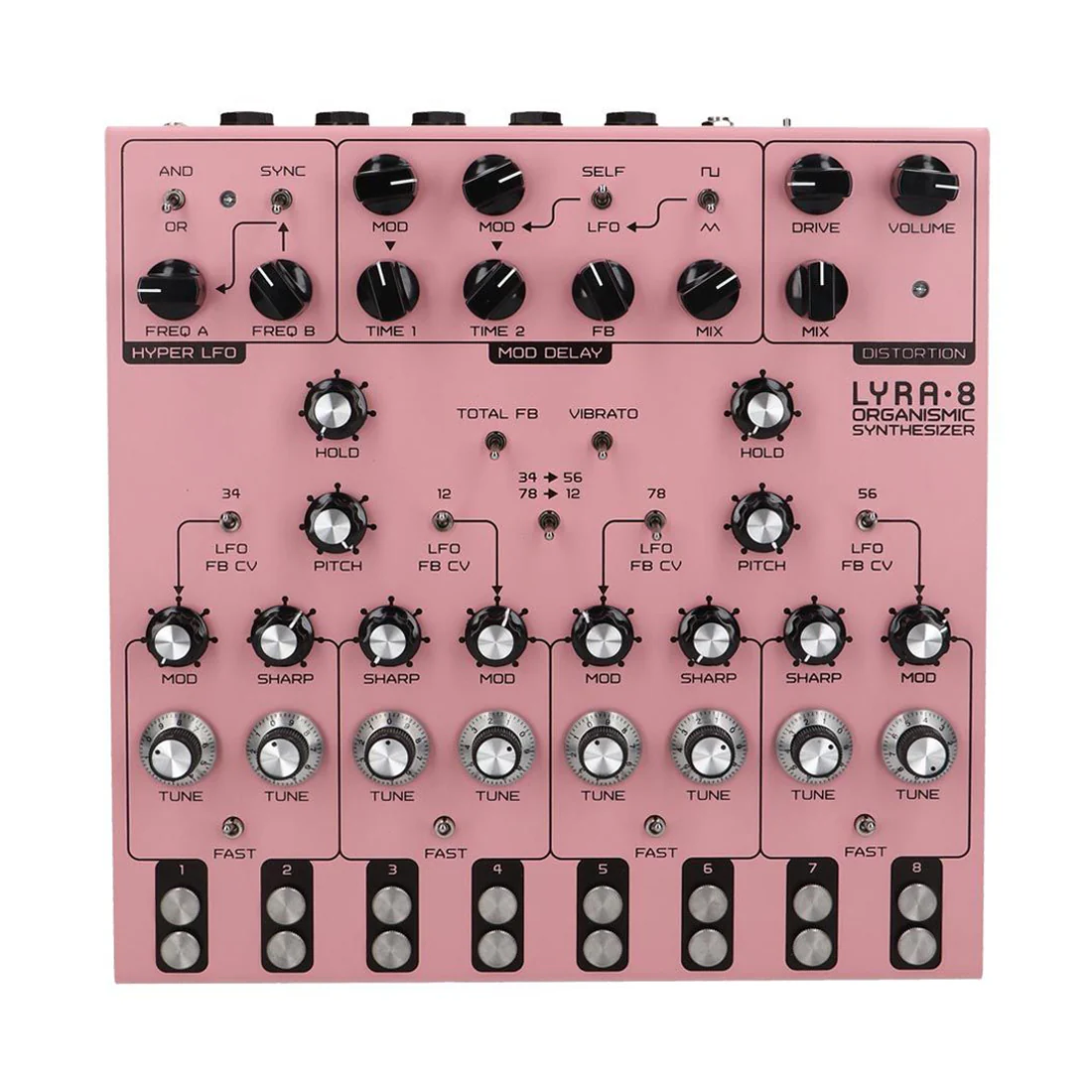
The voices are divided into four pairs (12, 34, 56, 78). All the pairs are divided in two groups, with two pairs in each (1234, 5678), creating tree-like structure.
The voices can function either in an electric organ mode or in an FM synthesis mode with each of the voices and its envelope acting as a separate FM operator. The voice’s impact on FM synthesis will decrease along with the decay of its envelope.
LYRA-8 also has the next blocks:
The HYPER LFO is a complex low-frequency generator, whose waveform is synthesized from two simple LFOs by summation or multiplication of their frequencies. It also has a sync mode. The LFO can modulate the selected pairs of voices and the MOD DELAY.
The MOD DELAY consists of two lines of delay with cross-feedback and a special architecture that enables resonance between the two lines. Each line’s delay time can be individually modulated from various sources, including external ones. The delay has a unique possibility of self-modulation where the output signal modulates the delay sample rate, creating cool effects.
The DISTORTION is last in the chain, after the delay. It enables the delay to also influence the distortion.
For all its experimental character, LYRA is a professional instrument. Its output dynamics and frequency response are balanced and ready for a live performance or studio recording without any additional processing.
Product Information
Product Information
Shipping & Returns
Shipping & Returns

SOMA Laboratory Lyra-8 - Pink
SOMA Laboratory Lyra-8 - Pink
Welcome to the world of sound of LYRA-8, the unique organismic analogue synthesizer designed by Vlad Kreimer. “Organismic” means that LYRA uses some principles that lie in the base of living organisms. The way how LYRA’s modules interacting between each other and the behaviour of the instrument resembles a live conversation.
LYRA-8 is based on eight generators, which will be referred to as voices. Their design is not like a traditional subtractive synthesis VCO. Instead of having a linear or logarithmic dependency on control voltage, they resemble the tone generators in old electric organs. Hence the use of the term “voices” instead of “VCOs”. Lyra uses non-linearity a lot, and the voices are constructed in such a way that allows for non-linearity to express itself.
The voices are divided into four pairs (12, 34, 56, 78). All the pairs are divided in two groups, with two pairs in each (1234, 5678), creating tree-like structure.
The voices can function either in an electric organ mode or in an FM synthesis mode with each of the voices and its envelope acting as a separate FM operator. The voice’s impact on FM synthesis will decrease along with the decay of its envelope.
LYRA-8 also has the next blocks:
The HYPER LFO is a complex low-frequency generator, whose waveform is synthesized from two simple LFOs by summation or multiplication of their frequencies. It also has a sync mode. The LFO can modulate the selected pairs of voices and the MOD DELAY.
The MOD DELAY consists of two lines of delay with cross-feedback and a special architecture that enables resonance between the two lines. Each line’s delay time can be individually modulated from various sources, including external ones. The delay has a unique possibility of self-modulation where the output signal modulates the delay sample rate, creating cool effects.
The DISTORTION is last in the chain, after the delay. It enables the delay to also influence the distortion.
For all its experimental character, LYRA is a professional instrument. Its output dynamics and frequency response are balanced and ready for a live performance or studio recording without any additional processing.
Product Information
Product Information
Shipping & Returns
Shipping & Returns
Description
Welcome to the world of sound of LYRA-8, the unique organismic analogue synthesizer designed by Vlad Kreimer. “Organismic” means that LYRA uses some principles that lie in the base of living organisms. The way how LYRA’s modules interacting between each other and the behaviour of the instrument resembles a live conversation.
LYRA-8 is based on eight generators, which will be referred to as voices. Their design is not like a traditional subtractive synthesis VCO. Instead of having a linear or logarithmic dependency on control voltage, they resemble the tone generators in old electric organs. Hence the use of the term “voices” instead of “VCOs”. Lyra uses non-linearity a lot, and the voices are constructed in such a way that allows for non-linearity to express itself.
The voices are divided into four pairs (12, 34, 56, 78). All the pairs are divided in two groups, with two pairs in each (1234, 5678), creating tree-like structure.
The voices can function either in an electric organ mode or in an FM synthesis mode with each of the voices and its envelope acting as a separate FM operator. The voice’s impact on FM synthesis will decrease along with the decay of its envelope.
LYRA-8 also has the next blocks:
The HYPER LFO is a complex low-frequency generator, whose waveform is synthesized from two simple LFOs by summation or multiplication of their frequencies. It also has a sync mode. The LFO can modulate the selected pairs of voices and the MOD DELAY.
The MOD DELAY consists of two lines of delay with cross-feedback and a special architecture that enables resonance between the two lines. Each line’s delay time can be individually modulated from various sources, including external ones. The delay has a unique possibility of self-modulation where the output signal modulates the delay sample rate, creating cool effects.
The DISTORTION is last in the chain, after the delay. It enables the delay to also influence the distortion.
For all its experimental character, LYRA is a professional instrument. Its output dynamics and frequency response are balanced and ready for a live performance or studio recording without any additional processing.